





New feature alert! Answer validation with regex 📣

  • April 15, 2026
  • 2 replies
  • 34 views
product updates
Grace
Community Team
Forum|alt.badge.img+5

Hi folks,


We are excited to announce that one of our most requested features has made it into Typeform, and is now available on all paid plans 🎉 (excluding legacy).


Answer validation with regular expressions (regex) means you can now set rules for information to be collected in a specific format. So if you are asking for official document numbers, IDs, IBANs or other important information, this is going to be a game changer! 


You can add Answer validation to:

  • Long text questions
  • Short text questions
  • Email questions 
  • Coming soon: Website questions 👀


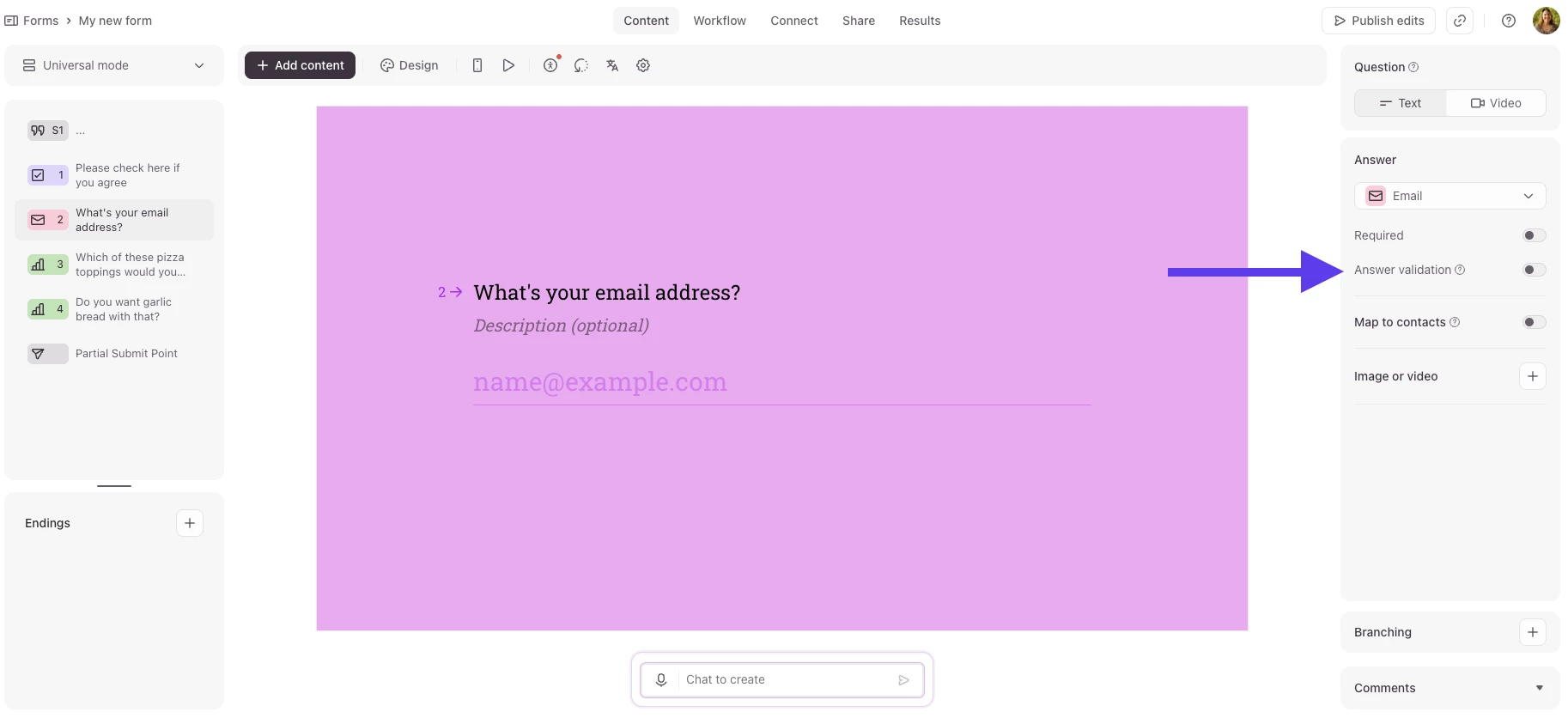
You will find the option to toggle on this feature in the right hand panel:


If you need help creating a validation pattern, you can ask Typeform AI to generate it:
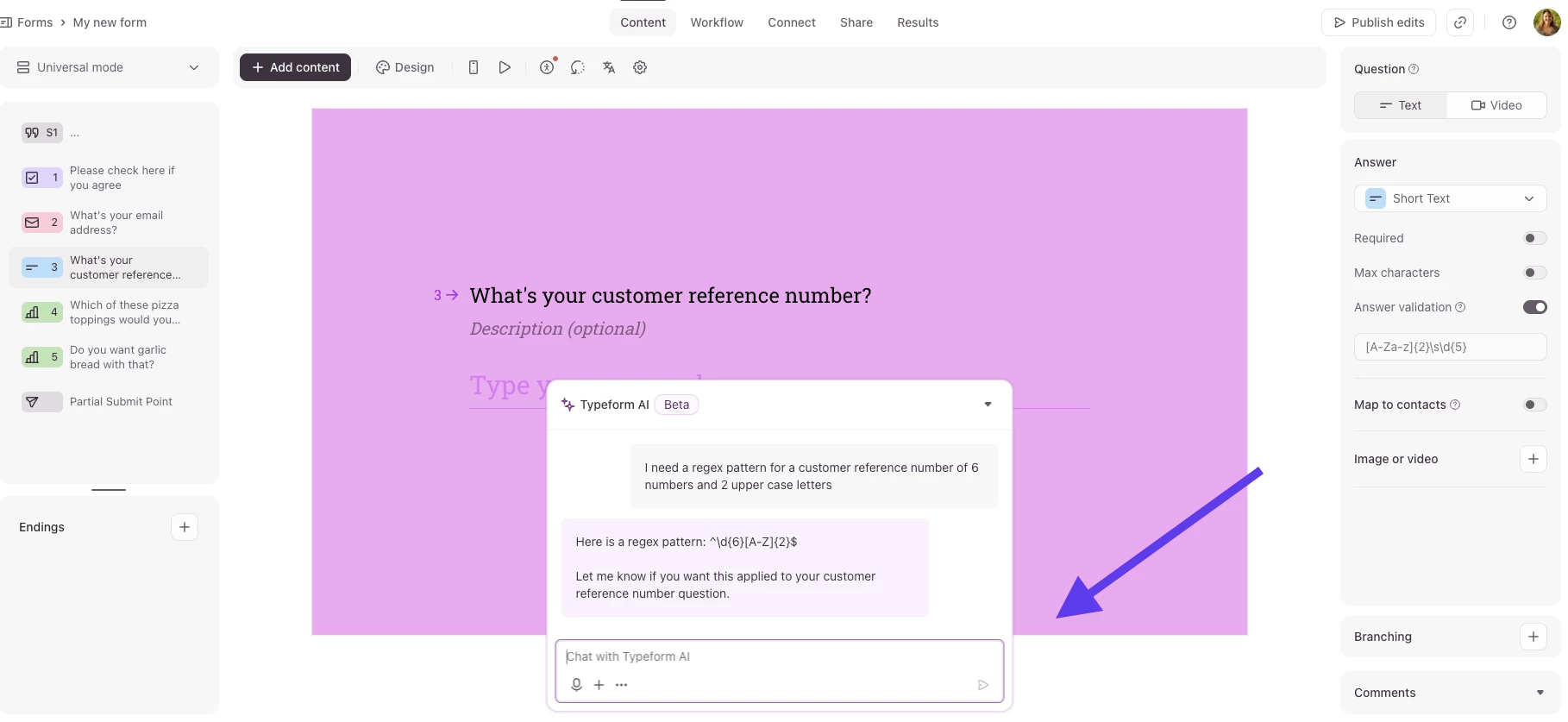


Add your regex pattern to the Answer validation field and test it out in preview mode to make sure it works. If someone enters an incorrect sequence, they will see a message asking them to input a valid format.


For full details on this new feature, check out the Help Center article here.


Let us know in the comments if you give it a try!

2 replies

  • Navigating the Land
  • April 17, 2026

Excellent!


  • Navigating the Land
  • April 17, 2026

New! 

Subject: Equipping the Vanguard: A Strategic Proposition for Typeform’s Next Era

Congratulations on the ongoing success of Typeform! This new feature is so useful today as each institution has different formats (e.g. U.S passport vs. State ID card of one state to another vs Spanish/EU ID cards and passports etc. ).

 I write this with immense admiration. I also write with a strategic proposition for the CEO.

The current architecture of user tiers leaves a vital demographic isolated. Legacy users are missing out. This was once a calculated strategy. It is now a missed opportunity.

Consider the architecture of a technological giant during an era of profound disruption. Apple faces accusations of lagging in the AI arms race. But it relies on its legacy champions. Steve Wozniak steps forward.

He watches competitors bleed themselves in the red ocean of rapid feature-shipping. He declares that Apple remains anchored in its foundational excellence. Apple continues doing what it does best. It contracts with others for the rest.

The Pentagon operates the same way. The legacy champion acts as the ultimate shield. They provide the narrative bedrock when the winds of change threaten to strip a company of its identity.

Typeform possesses this exact same asset. We are the active Legacy users. We are the original ambassadors who forged your early growth.

We do not advocate for Typeform to harvest affiliate commissions. We champion the platform for the love of the design. We advocate for the art. We recognize the profound aesthetic value you brought to data collection.

But time has passed. We are no longer young enthusiasts building small side projects. We are well past forty. We hold senior positions in Fortune 500 corporations.

We possess the authority to push resistant IT departments to allocate massive enterprise budgets. We fight the internal bureaucratic battles.

We ensure Typeform is installed at the highest levels. My own corporation recently acquired a massive enterprise account directly because of this internal advocacy.

The original strategy of gating features to force Legacy upgrades is obsolete. The remaining Legacy accounts belong to your most fervent loyalists.

→  I propose a shift in policy. Grant all active Legacy accounts full access to new features. Move them forward. Treat them as your vanguard.

Look to the survival mechanisms of enduring institutions. The King of England understands this calculus perfectly. New generations emerge devoid of innate royalist sentiment. The Monarchy survives by elevating its legacy generations.

The Crown lavishes titles and invitations upon those who turn up to the parades. These legacy champions then infect the younger generations with their enthusiasm. The institution endures.

Typeform must adopt this same noble strategy. Equip your oldest loyalists with your newest tools. Keep this group passionate.

We are the natural, undisputed marketing muscle of your enterprise. Arm your vanguard.

Thank you for your time and vision. Much love from a Typeform super-lover. <3 !!!
__________________________

Whilst I am here, new innovative request time as well let’s have one more strategic proposition, because this is where the future is already heading.

Typeform should seriously consider allowing both account holders and respondents to bring their own AI keys into the experience. OpenAI. Anthropic. OpenRouter. Let the power users plug in what they already trust and already pay for.

This would not cannibalise Typeform’s own AI offering. It would do the opposite. It would expand the universe of use cases without forcing Typeform to carry every cost, every edge case, and every institutional requirement on its own balance sheet.

Your native AI can remain the default. Clean. Simple. Turnkey. Perfect for the mainstream. Bring-your-own-key would serve a completely different layer of demand: enterprise, research, education, advanced consulting, long-form guided workflows, expert elicitation, high-volume qualitative analysis, and creatively adapted Typeform use cases that stretch far beyond ordinary forms.

Different users want different things. Some want convenience. Some want control. Some need procurement approval tied to their own vendor stack. Some need data governance comfort. Some need model choice. Some already have internal AI budgets and are simply not going to route serious usage through a bundled black box, no matter how elegant it looks.

And let us be honest. OpenAI and Anthropic are not obscure experimental names. These are globally trusted, multi-billion-dollar AI brands. In many organisations, letting a respondent or client use their own approved AI account is not a bug. It is the compliance solution.

Now imagine the upside.

A paid Typeform user creates a very large survey, interview flow, training sequence, educational simulation, advisory intake, or discovery process. The respondent is then given the option to answer manually, use Typeform AI, or connect their own approved AI key to help generate, refine, structure, summarise, translate, compare, or expand their responses. Suddenly the survey stops being a static form and becomes a live thinking environment.

That is a different category of product.

It is especially powerful for long surveys where fatigue kills completion. It is powerful in instructional settings where people need help understanding the question before answering it. It is powerful in multilingual environments. It is powerful in expert and B2B settings where the respondent has knowledge but not time. It is powerful wherever Typeform is being used less as a “form” and more as a beautifully designed interactive workflow.

Most importantly, it lets Typeform become the orchestration layer rather than needing to be the sole fuel source.

That is a very strong strategic position.

The winners in this next phase may not be the companies that insist on owning every token. The winners may be the ones that build the most elegant, trusted, and flexible environment in which many forms of intelligence can be brought to work.

Typeform already owns elegance.
Typeform already owns flow.
Typeform already owns the emotional feel of a better interface.

Now there is a chance to own the bridge between forms and AI-native interaction.

That would be very Typeform.
That would be genuinely forward-looking.
And that would make a lot of your most inventive users very, very happy.

If you want, I can also tighten your whole post so the original body and this P.S. feel like one seamless, punchier piece.