


Get ready to unwrap smarter holiday marketing strategies!
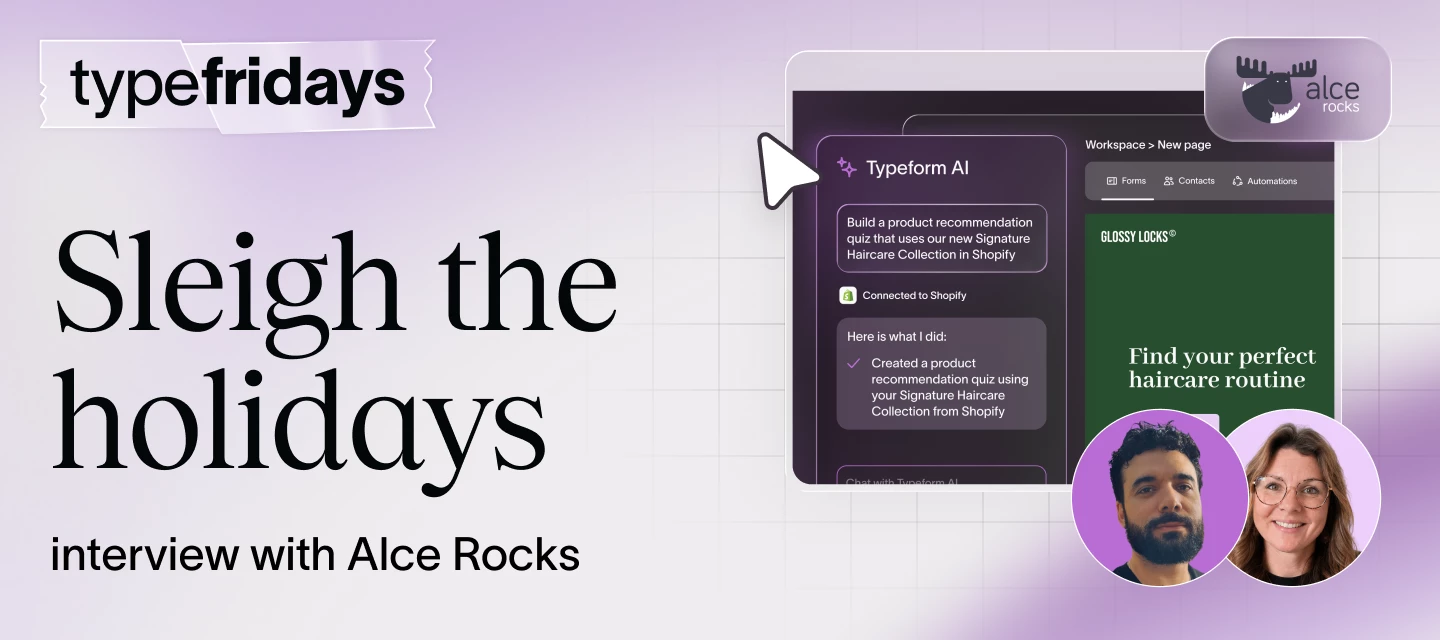
We recently hosted our Sleigh the holidays workshop, where we chatted with Typeform and Shopify partner Igor de Andrade, Co-Founder of Alce Rocks. Whether you missed the live session or just want a quick reference guide, this article compiles Igor's top insights on capturing zero-party data, designing high-converting product quizzes, and building seamless automated workflows that drive sales far beyond the holidays.
Strategy & campaign timing
Q: When is the best time to launch holiday marketing forms and quizzes, and how often should brands target their audience?
A: Launching during the peak holiday noise (Black Friday/Cyber Monday) makes it hard to break through. Instead, divide your strategy into two clear phases:
-
Evergreen Phase (Year-Round): Run list-building and preference quizzes all year long. This builds a strong foundation of customer profile data without forcing high-volume promotional messages.
-
Promo Phase (Mid-November / Late October): Launch specific Black Friday or holiday time-boxed promotions using the data collected during the evergreen phase.
Frequency Tip: Prioritize cadence over volume. Space out 2 to 3 touches using different psychological triggers rather than repeating the same message:
-
Touch 1: Curiosity
-
Touch 2: Incentive / Value proposition
-
Touch 3: Genuine last chance
Product recommendation quizzes vs. general email marketing
Q: Why should an e-commerce brand use a product recommendation quiz instead of standard email blasts?
A: Standard email marketing only captures basic clicks. A well-designed product recommendation quiz can do the following:
-
Capture zero-party data: Collects explicit, intentional preferences directly from the customer rather than making educated guesses.
-
Eliminate "Holiday choice paralysis": Acts as a digital concierge, helping shoppers navigate large catalogues—especially when buying gifts for friends and family.
-
Power long-term personalization: Feeds declared attributes directly into your CRM (e.g., Klaviyo) and e-commerce platform (e.g., Shopify) to make future email campaigns and store recommendations significantly sharper.
Form design & respondent experience
Q: How can brands balance collecting enough data without causing respondents to drop off?
A: Keep perceived effort low and relevance high by following these practical rules:
-
The actionability rule: Only ask questions that yield an immediate, actionable result or recommendation. If you cannot name a direct use for the data point, remove the question.
-
Keep length manageable: Aim for a target of 5 to 8 questions (unless complex health or pharmacy recommendations require more detail).
-
Leverage conditional logic: Use branching logic so users never see irrelevant questions. Use early answers to dynamically shape later questions (e.g., "Since you mentioned liking X...").
-
Ask for email last: Place email/contact capture fields at the end of the form after the customer has already seen the value of their responses.
-
Display one question per screen: Combined with progress bars and micro-feedback loops, single-question screens create a conversational flow that reduces form fatigue.
Q: How critical is visual branding on a Typeform?
A: Visual design signals trust and effort, which directly improves completion rates. While you don't need over-the-top seasonal decorations for every screen, you should ensure:
-
Brand identity match: Use consistent colors, logos, and typography to create a seamless transition between your e-commerce storefront and the form.
-
High-impact screens: Customize at least the Welcome Screen and Ending Screen to reflect your brand identity or seasonal themes.
Re-watch the workshop: Wine and Design for more tips and best practices on Typeform design techniques 🎨
Personalization & incentive strategies
Q: What are the best ways to personalize the form experience for returning or segmented users?
A: Use URL parameters to automatically pass known parameters (such as name, email, traffic_source, or campaign_id) via URL strings so respondents don't have to re-enter basic details. Map responses into custom tags and meta-fields in your CRM to continuously refine the buyer profile.
Q: Should brands offer discounts or rewards to drive quiz completions?
A: Treat the recommendation itself as the main reward (e.g., discovering the exact skincare routine or ideal wine pairing).
-
Avoid making a discount the sole reason to fill out the form. Position promotional codes, free shipping, or gift-guide bundles as an added surprise bonus at the final results screen to double the payoff.
Integrations & technical workflows
Q: What are the recommended workflows for connecting Typeform with Shopify and CRMs like Klaviyo?
A:
-
Shopify flow & customer tags: Pass quiz responses directly into Shopify as customer tags or meta-fields. Use Shopify Flow to trigger automated actions, personalize storefront content, or build personalized cart URLs based on quiz results.
-
Enriched abandoned cart flows: Sync zero-party data to your CRM (e.g., Klaviyo) to transform standard abandoned cart emails into personalized follow-ups tailored to the customer's specific quiz preferences.
-
Pre-filled carts: Direct respondents straight from the quiz ending screen to a pre-filled cart or custom-curated product collection.
Q: What automation workflows help internal teams leverage form data efficiently?
A:
-
Google Sheets integration: Sync responses automatically using native integrations or Zapier to monitor live campaign trends without needing complex reporting software.
-
Slack & email alerts: Set up instant notifications for high-intent or high-ticket B2B submissions.
-
AI agent pipelines (Experimental): Pipe anonymous response data into internal AI models to analyze common customer inquiries and assist support reps in generating faster, highly accurate responses.
Q: Should payments be collected directly inside Typeform or via standard checkout?
A:
-
Use native e-commerce checkout: If you already operate a full Shopify/e-commerce store, route users back to your native storefront checkout to preserve a unified customer journey.
-
Use Typeform payment question (Stripe/PayPal integration): Ideal for standalone product drops, pre-orders, gift cards, event registrations, digital goods, or businesses operating without a full e-commerce setup.
Measuring Success & Key Metrics
Q: Which metrics should marketers prioritize when evaluating campaign success?
A:
| Funnel Stage | Key Metric | What It Tells You |
| Top of Funnel | Completion Rate & Question Drop-Off | Identifies friction points and shows if specific questions are confusing or unnecessary. |
| Conversion | Submission Rate & Sourced Revenue | Tracks immediate sales originating from specific quiz segments. |
| Long-Term Value | Customer Repeat Rate & Segment Quality | Evaluates retention and how effectively zero-party data fuels long-term personalization. |
You can find the full workshop recording, and more Typeform resources over here:
Thanks so much to Igor for taking the time to join us, if you have any questions about what we discussed, feel free to drop them in the chat below.
[PS. This article was created using the live workshop transcript and a little help from AI 😉]